 Overview
Velora - Designing the Future of Experience Travel
How an AI-powered trip planning platform closes the gap between a $369B market opportunity and the fragmented, impersonal booking reality travelers face today.
MY ROLE
Lead Product Designer
DURATION
2 months
Team
2 Designer, 1 Senior Manager, 1 Managing Director
Scope
0-1 MVP, Research synthesis, Interactive Prototype, High Fidelity Design
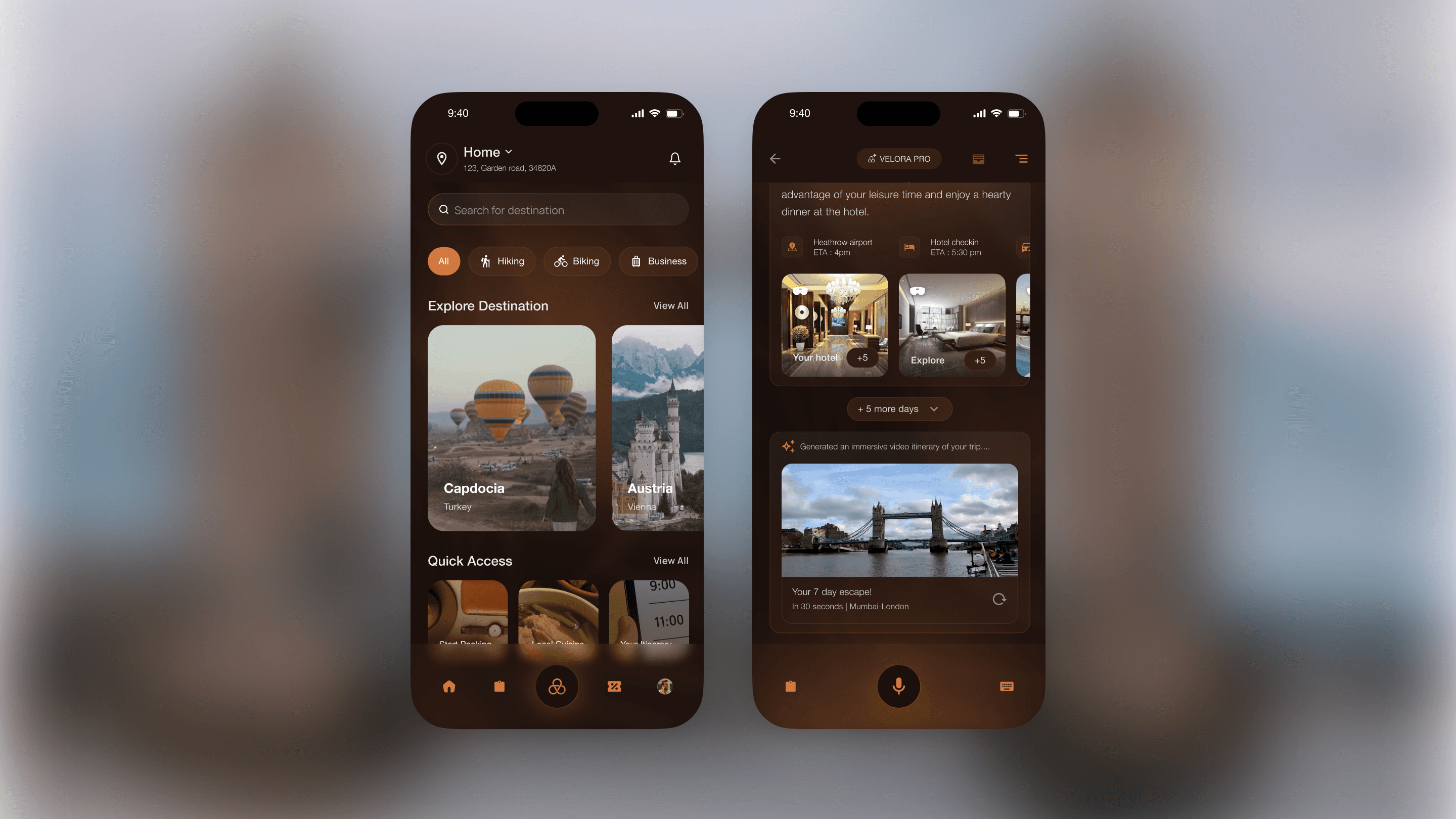
The context
Experience travel is the fastest-growing segment in a $369B market
The global travel industry has been reshaped by a fundamental shift — people are spending on experiences over possessions. 52% of Gen Z travelers splurge on experiences, compared to only 29% of Boomers. The experience travel segment is growing at 14%+ per year. And yet, the digital infrastructure built to serve this market hasn't kept pace.
14%+
Experience segment growth per year
22%
Bookings via dedicated travel platforms — vs. 47% still offline
— VIK KRISHNAN, SENIOR PARTNER, MCKINSEY & COMPANY
The Problem
Travelers today have more options than ever and less reason to trust any of them.
47% of bookings still happen offline. Not because travelers avoid technology — but because existing digital platforms haven't solved the real problem. Listings are inaccurate. Booking is fragmented across 6+ platforms. Activities are unverified. Recommendations are generic. And when something goes wrong mid-trip, there's no intelligence to catch it — only a support queue.
The platform needed to address all of this — not as separate feature requests, but as a connected system built around how people actually travel.
The Approach
01
Understand the space
Secondary research on market trends and traveler behaviour. Competitor analysis across major booking platforms. Identify where the gaps are — and why incumbents haven't filled them.
02
Understand the users
Primary research with frequent travelers across two distinct travel styles. Build personas grounded in real behaviour, not assumptions. Map the full journey to find where trust breaks down.
03
Define the problem
Synthesise research into a clear problem statement and a set of design principles. Prioritise what to solve and in what order — before touching the product.
03
Design and test
Lo-fi flows → mid-fi prototypes → hi-fi screens. Usability testing at mid-fi stage. Iterate based on findings before handoff.
Research & Discovery
Understanding the traveler — and the platforms failing them
Primary Research — User Interviews
I conducted 4 interviews with travellers, stakeholders to identify pain points and needs. The research revealed that friction isn't isolated. It cascades across the entire experience. We clustered the research into 5 pain points
Experience listings suffer from misleading content, eroding trust before the journey begins.
Multi-step, fragmented processes across platforms create friction and booking abandonment.
No systematic vetting of tour operators leads to quality inconsistency at the destination
Large datasets are leveraged for breadth, not depth — resulting in generic, one-size-fits-all recommendations.
Reactive Support
Customer care operates in response mode, missing opportunities to prevent disruption proactively.
Competitor Analysis
Audited four major platforms across the booking and experience travel space and evaluating them on discovery, booking flow, personalisation, trust signals, and post-booking support. The goal was to understand not just what they do, but why the gap between platform promise and traveler reality persists.




Platforms depend on ratings and reviews rather than building strong, verifiable trust signals into the experience.
Flights, stays, and experiences are treated as separate transactions—users are left to stitch the trip together themselves.
Recommendations are largely filter based and generic, with little understanding of user intent, preferences, or context.
Large inventories create choice overload, but don’t meaningfully guide users toward culturally or intellectually aligned experiences.
Support is reactive, not proactive
Assistance typically begins after a disruption occurs, with minimal real-time intelligence or guided recovery during critical moments.
Competitor Analysis - Market signals
69%
of travelers are planning a solo trip this year — demanding personal, not group-generic, recommendations.
223%
increase in Google searches for 'solo travel' over 10 years — a sustained shift, not a trend.
91%
of travelers say ethical travel is important — yet no major platform verifies this at the listing level.
40%
of high-net-worth travelers will pay a premium for sustainability-focused options — a monetisable trust signal
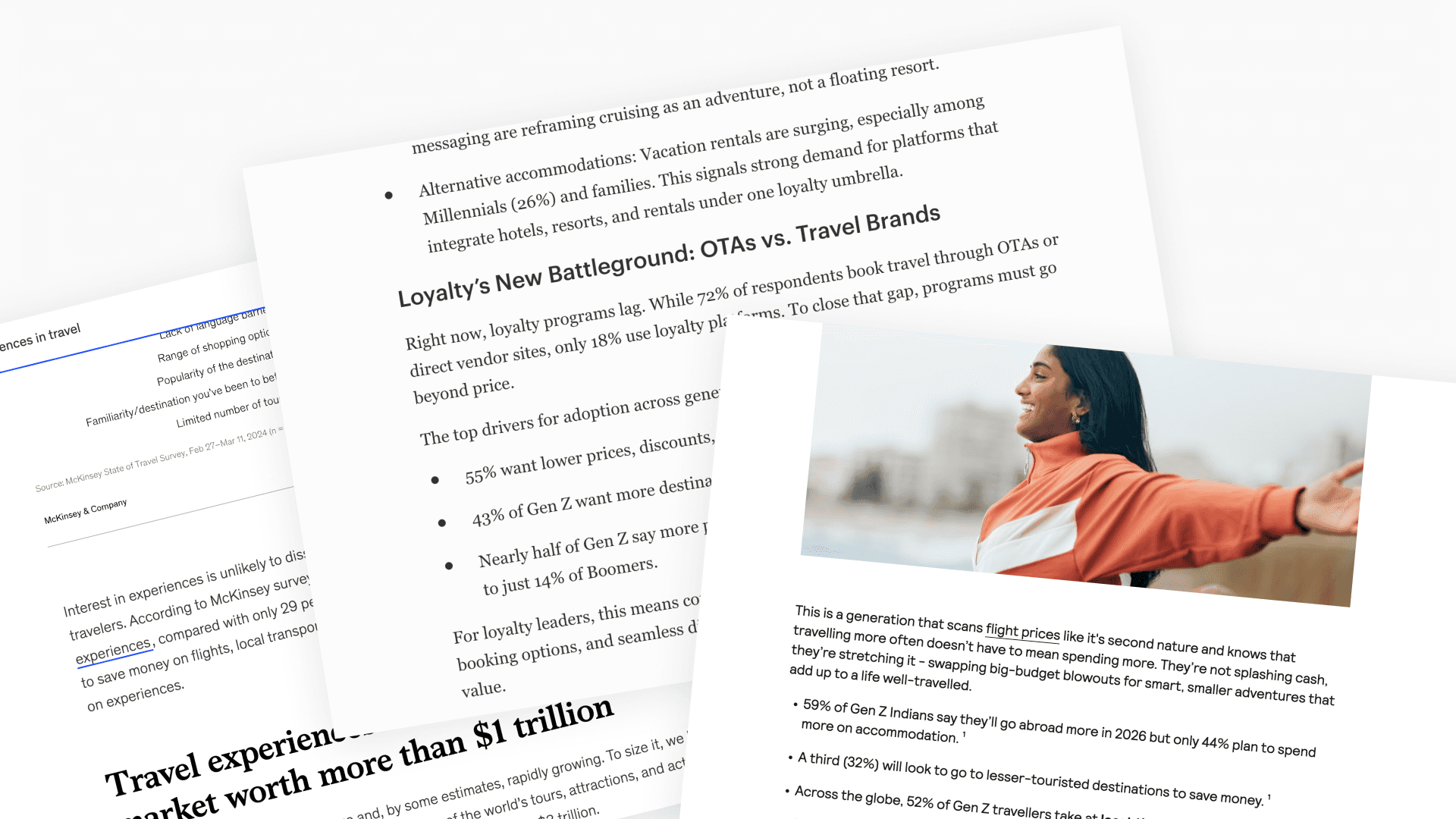
McKinsey, Forbes, Skyscanner
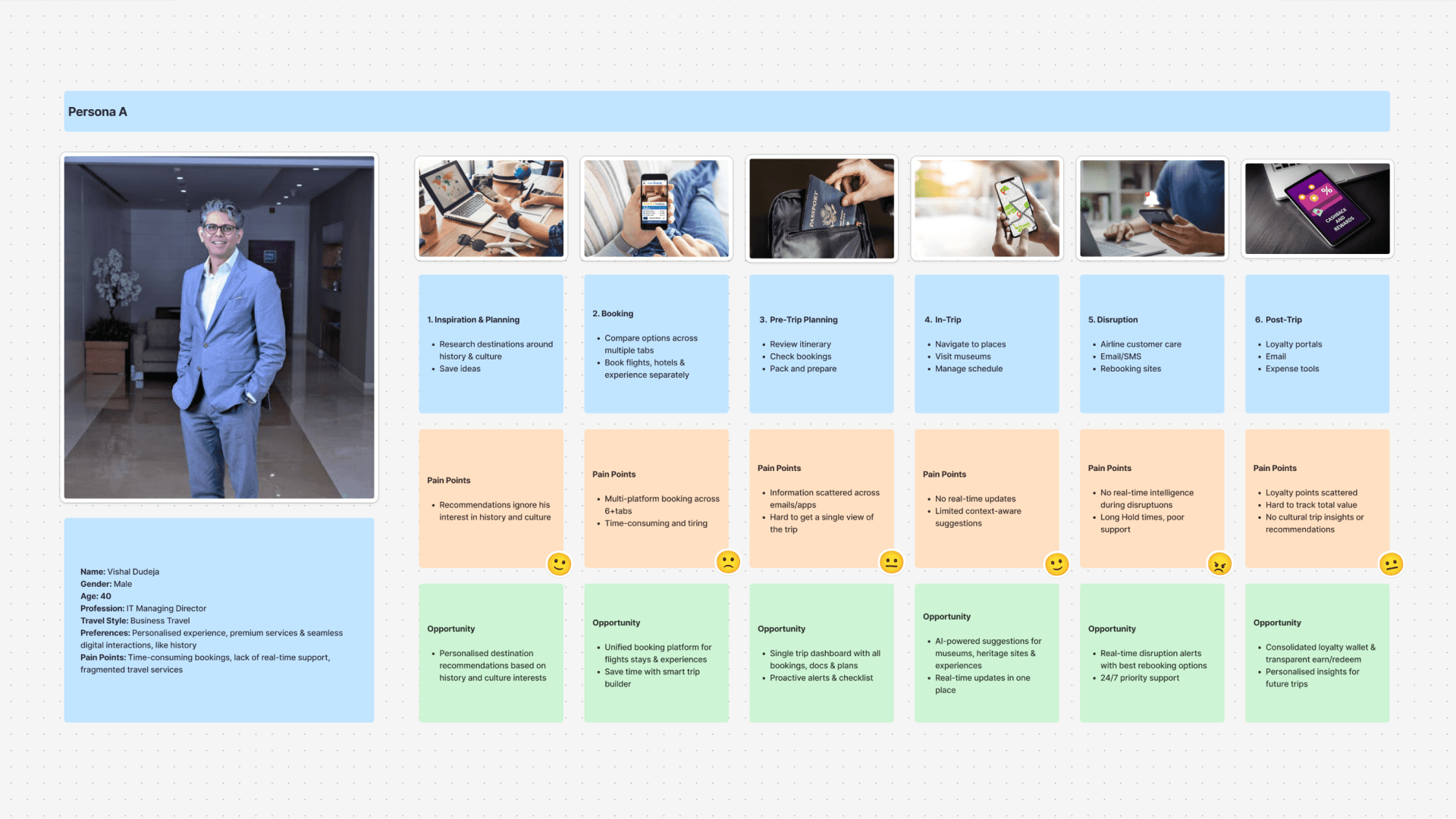
Persona
Two travelers surfaced from research —
Interviews and behavioural data converged on two distinct archetypes. They share the same five problems but encounter them at different moments, with different stakes. Every feature decision in this product was stress-tested against both.

PERSONA A
Vishal Dudeja
Managing Director, 45, Bangalore
Luxury & Business
History Enthusiast
Premium Digital
Vishal travels 14–18 days a month, blending business with cultural exploration. He plans trips around museums, ruins, and intellectual culture — not tourist trails. He books premium and expects precision. His scarcest resource is time: every extra click, every unresolved disruption, every fragmented loyalty program is a compounding cost.
PAIN POINTS
Multi-platform booking across 6+ tabs for a single trip
No real-time intelligence when disruptions happen mid-journey
Loyalty points scattered across airline, hotel, and experience programs
Destination recommendations that ignore his interest in history and culture

PERSONA B
Shweta Roy
IT Employee · 28 · Bangalore
Solo Trips
Organic Experiences
On-the-Go Planning
Shweta plans in hours, not weeks. A long weekend, a flash sale, a friend's suggestion — she moves fast. She values local authenticity over luxury: street food over hotel dining, lesser-known trails over tourist circuits. Her core challenge is trust: she needs to know that what a listing promises is what she will actually find.
PAIN POINTS
Activity listings that don't match the real experience at the destination
Hectic, multi-tab booking under time pressure when planning last-minute
Sudden plan changes — flight delays, cancellations — with no smart fallback
Recommendations that feel like a copied listicle, not a personal suggestion
DEFINE
How might we?
design principle
Anticipate, Don't React
The AI surfaces needs before users voice them — rerouting, upgrading, and suggesting based on context.
One Interface, Two Journeys
James gets premium precision; Aparna gets spontaneous discovery. The same product adapts its voice
Invisible Complexity
Booking a flight, hotel, transfer, and itinerary happens in one flow. Users never feel the system's depth.
Data Without Trust by Default
Verified activities, authenticated guides, and transparent sustainability credentials are built-in, not add-ons.
The Solution
A continuous travel companion — not just a booking tool
The product was structured across the full travel arc: Pre-Trip, During Transit, At Property, and Post-Trip. Rather than solving for the booking moment alone, the platform stays with the traveler. Always personalising, adjusting, and supporting at every stage.
Pre-Trip
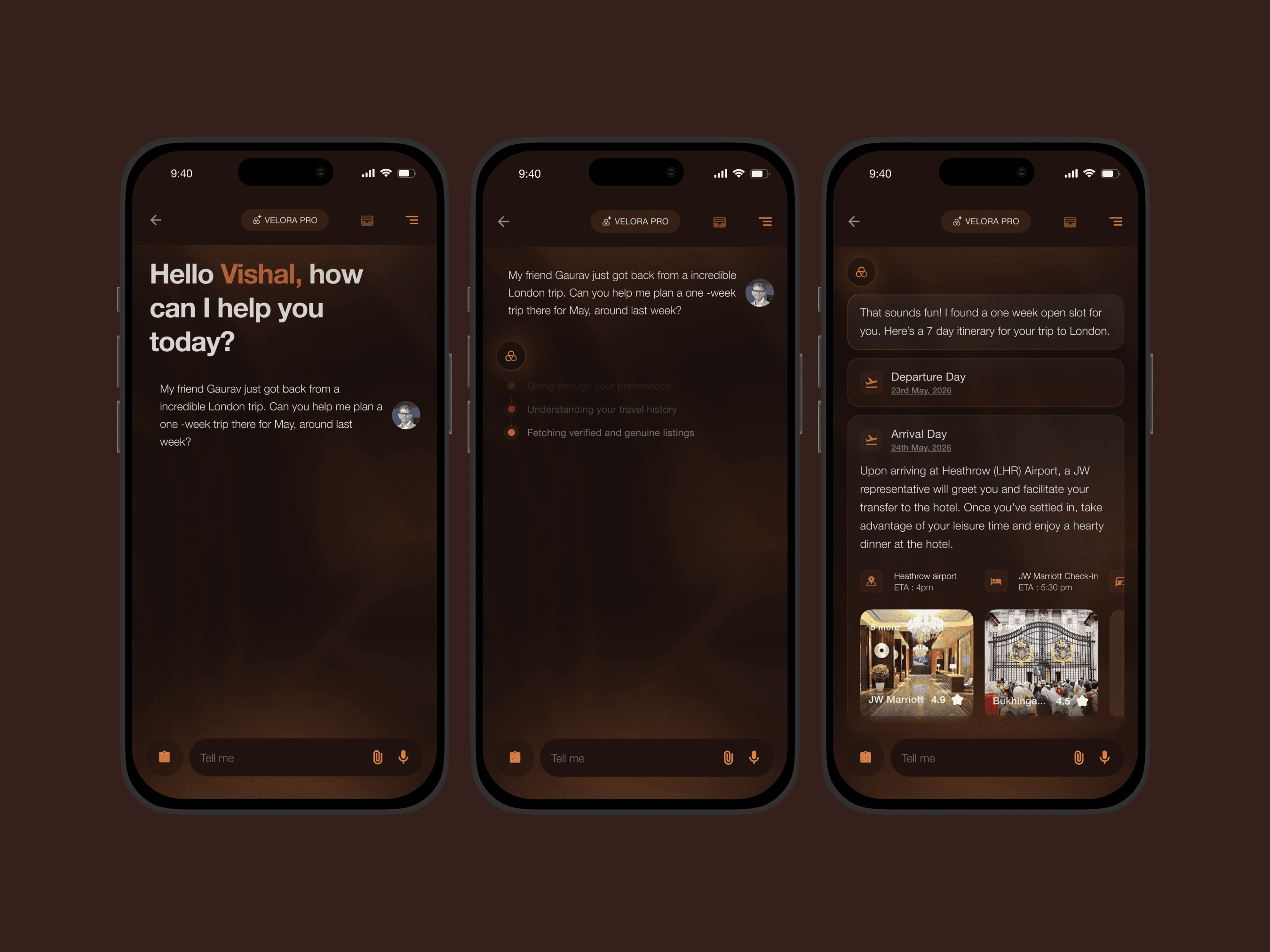
AI-guided trip setup
A traveler just states the intent. Velora figures out the destination, dates, travel style and generates an itinerary, books flights, hotel, and transfers in one flow. Replaces the 6-platform, 4-session booking reality.
Personalised itinerary creation
Vishal receives a history-led, cultural, itinerary. The system learns from past bookings, loyalty tier, and stated preferences.
Verified listings and trust badges
Hotel chains, experience provider, restaurants all go through a well-vetted journey. It shows what is actually good and better rated for Vishal. Not the generic rating for all.
Transit
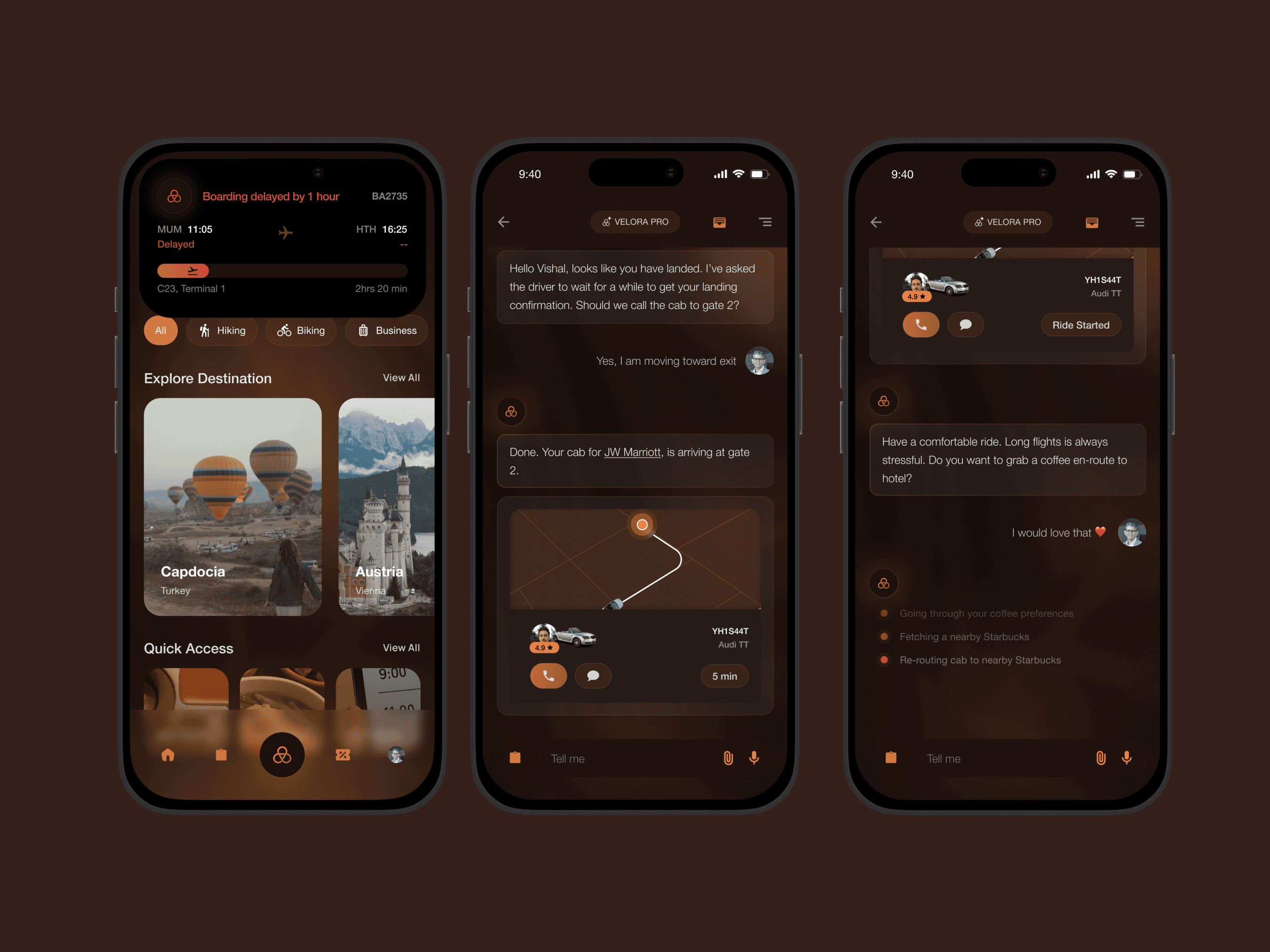
Real-time flight and transport updates
Proactive alerts reach the traveler before they check the airline app. The platform monitors, the traveler doesn't have to.
Autonomous itinerary adjustment
When a flight is delayed, the AI automatically re-arranges affected transfers and activities with no call required, no queue.
Local activity suggestions en route
Context-aware recommendations during delay/tiring journey. All based on available time, current location, and preference profile.
On Trip- At Property
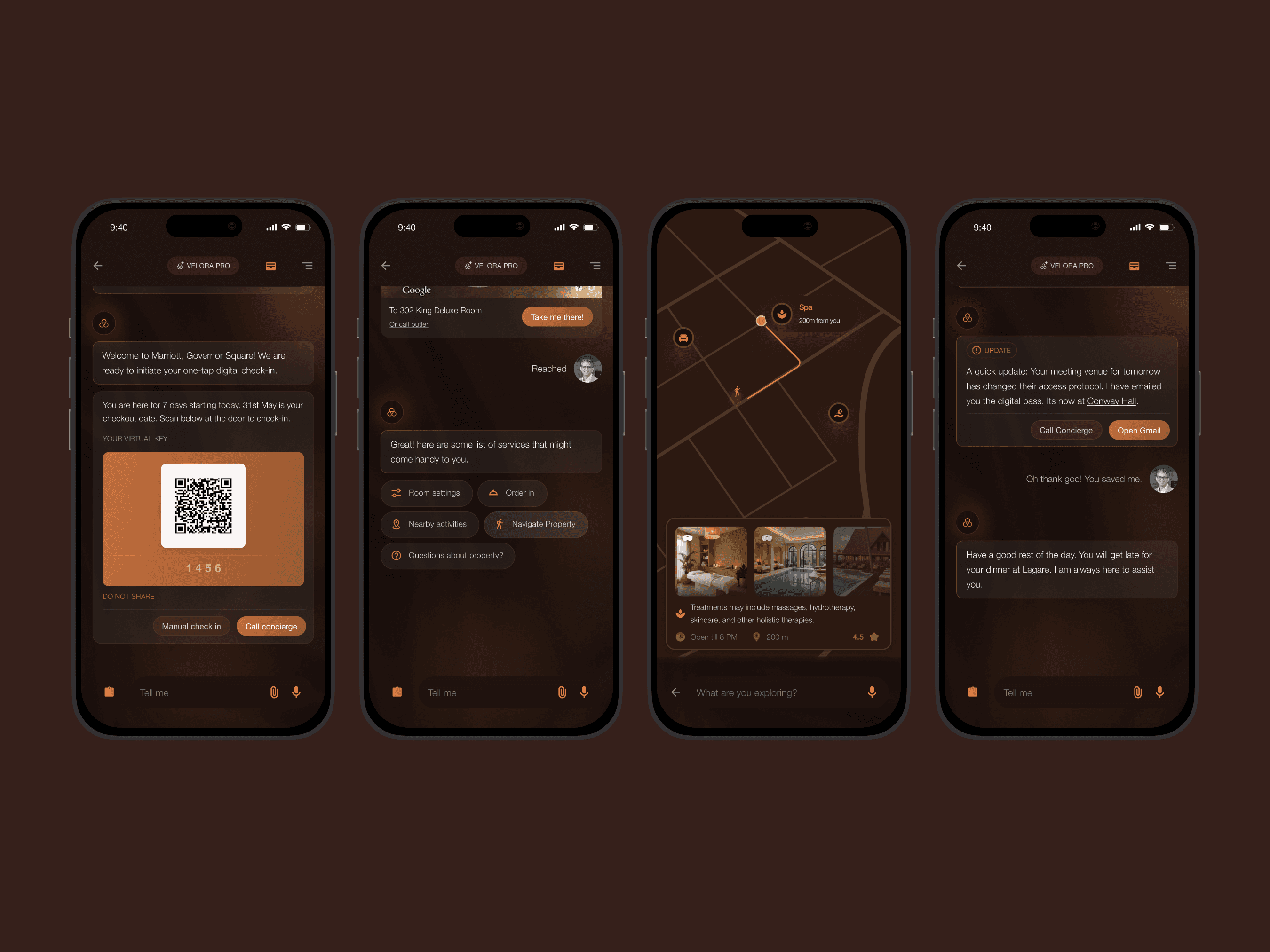
Digital check-in
Room key, floor plan, and amenity details delivered on arrival notification. Zero queue.
Personalised in-room experience
Quick access to features of room, nearby activities and more.
On-demand assistance
Immediate help without locating staff. Be it frequently asked questions, property navigation, all in one place.
Post-Trip
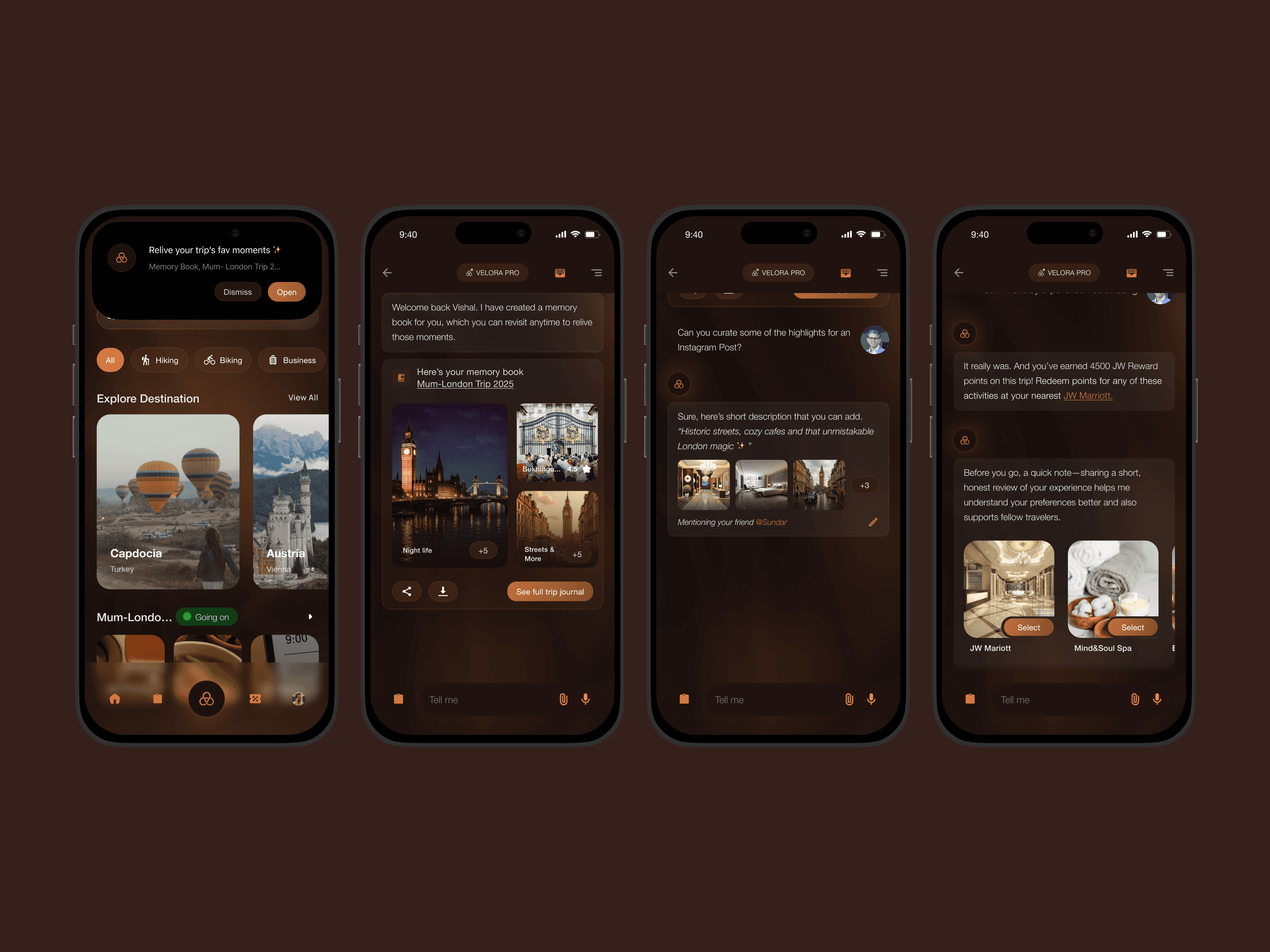
Trip recap and journal
A personalised travel memory of places visited, highlights, and a photo-forward summary. Built automatically from the itinerary. Not a generic booking history.
Created ready-to-go Insta worthy post for you!
Coming back to chat-gpt for mere content writing adds friction. Vishal can create post from your memory book and use the generated caption and merely with few texts, he is able to create beautiful aesthetic post.
Verified post-trip reviews
Only travelers who completed the booking can leave a review. Their feedback feeds directly back into listing accuracy and thus closing the loop on the inaccurate description problem.
Future travel recommendations
Next trip suggestions built on what the traveler actually did, rated, and returned to and not what's trending this week.
User Interface
Typography

It's a typeface with a long-standing association with premium, considered brands (high-end fashion, aerospace, Apple's earlier era). Clean, confident, no unnecessary personality which reads as understated luxury rather than trying too hard.
Color
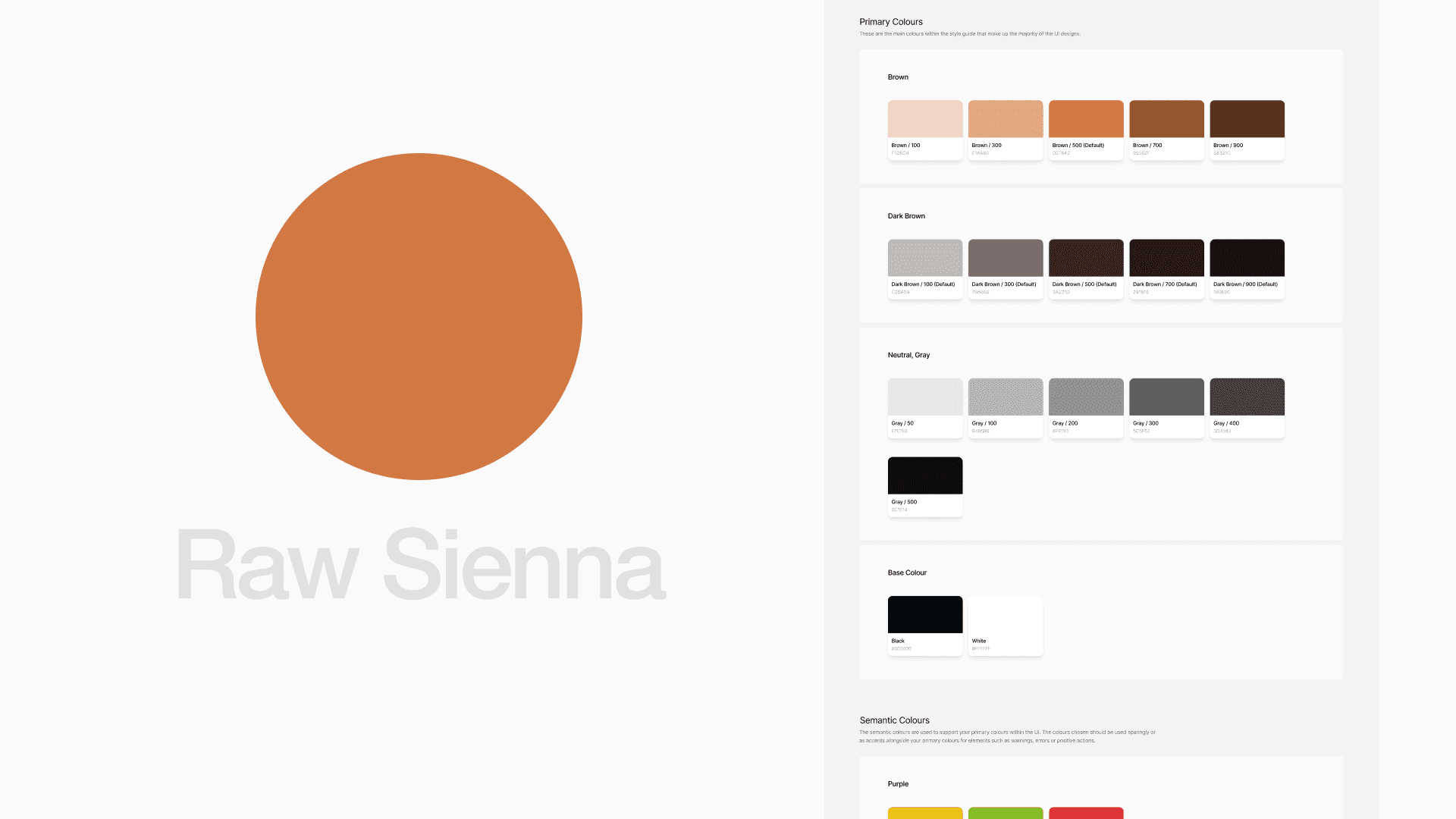
Orange and brown tones carry a sense of warmth and exclusivity. Unlike the typical "luxury = black/gold" approach, this palette feels more refined and travel-adjacent, evoking sunsets, exotic destinations, aged leather, premium materials. It signals wealth without being cold or corporate.
Impact & Opportunity
Measuring what matters to a market in motion
The platform targets a generation of travelers who will sacrifice everything except the experience itself. Success is measured not just in conversions, but in the trust and loyalty that booking incumbents have historically failed to earn.
3.2×
Faster booking completion vs. industry average
40%
Premium willingness for sustainability-focused trips
91%
Travelers who value ethical trip options
25%
Earnings improvement potential via digital analytics
WHAT WE MOVED
Discovery to booking
Reduced from avg. 4.2 sessions to 1 intent-guided flow
Offline-to-digital gap
Addressed through trust architecture and verified listings
Reactive → Proactive support
AI detects disruptions before travelers do
Fragmented loyalty
Single wallet aggregating 6+ program currencies
REFLECTIONS
The hardest design challenge wasn't the AI — it was deciding what the AI should not do. Preserving moments of genuine human serendipity inside a highly orchestrated system.
WHAT'S NEXT
→ Real-time translation layer for local engagement
→ Experience provider portal for verified onboarding
→ Predictive demand modeling for destination pricing
What we want?
Conclusion
The core challenge in designing Voyage AI wasn't technical — it was about trust. The 47% offline booking rate isn't a UI problem. It's a symptom of platforms that have optimised for transaction volume over traveler confidence. This product was built around the opposite bet: that if a platform could be genuinely reliable, genuinely personal, and genuinely proactive, travelers would choose it not because it was faster, but because it was better.
The hardest design decision was knowing what the AI should not automate. Travelers like Aparna want discovery to feel accidental — even when it isn't. Designing that sense of serendipity into an orchestrated system, without it feeling manufactured, was the work that didn't fit neatly into any brief.